Once we walk to the back-side of her the one broken-and-black heart,
we detect she's gone made. Totally mad.
But where are you?> this educator? She's no mine
no min---
Once we walk to the back-side of her the one broken-and-black heart,
we detect she's gone made. Totally mad.
But where are you?> this educator? She's no mine
no min---
| Rhythm and blues | |
|---|---|
 Ruth Brown was known as the "Queen of R&B".[1] | |
| Stylistic origins | |
| Cultural origins | 1940s–1950s, United States, from the Deep South. |
| Typical instruments | |
| Derivative forms | |
| Subgenres | |
| Fusion genres | |
| |
| Local scenes | |
| Other topics | |
Rhythm and blues, frequently abbreviated as R&B or R'n'B, is a genre of popular music that originated within the African-American community in the 1940s. The term was originally used by record companies to describe recordings marketed predominantly to African Americans, at a time when "rocking, jazz based music ... [with a] heavy, insistent beat" was starting to become more popular. In the commercial rhythm and blues music typical of the 1950s through the 1970s, the bands usually consisted of a piano, one or two guitars, bass, drums, one or more saxophones, and sometimes background vocalists. R&B lyrical themes often encapsulate the African-American history and experience of pain and the quest for freedom and joy, as well as triumphs and failures in terms of societal racism, oppression, relationships, economics, and aspirations.
The term "rhythm and blues" has undergone a number of shifts in meaning. In the early 1950s, it was frequently applied to blues records. Starting in the mid-1950s, after this style of music had contributed to the development of rock and roll, the term "R&B" became used in a wider context. It referred to music styles that developed from and incorporated electric blues, as well as gospel and soul music. By the 1970s, the term "rhythm and blues" had changed once again and was used as a blanket term for soul and funk.
In the late 1980s, a newer style of R&B developed, becoming known as "contemporary R&B". This contemporary form combines rhythm and blues with various elements of pop, soul, funk, disco, hip hop, and electronic music.
Although Jerry Wexler of Billboard magazine is credited with coining the term "rhythm and blues" as a musical term in the United States in 1948,[4] the term had been used in Billboard as early as 1943.[5][6] However, the company's first list of songs popular among African Americans was named Harlem Hit Parade; created in 1942, it listed the "most popular records in Harlem," and is the predecessor to the Billboard RnB chart.[7] "Rhythm and Blues" replaced the common term "race music", a term coined by Okeh producer Ralph Peer based on the common self description by the African American press as "people of race."[8][9] The term "rhythm and blues" was then used by Billboard in its chart listings from June 1949 until August 1969, when its "Hot Rhythm & Blues Singles" chart was renamed as "Best Selling Soul Singles".[10] Before the "Rhythm and Blues" name was instated, various record companies had already begun replacing the term "race music" with the term "sepia series".[11] "Rhythm and blues" is often abbreviated as "R&B" or "R'n'B".[12]
In the early 1950s, the term "rhythm & blues" was frequently applied to blues records.[13] Writer and producer Robert Palmer defined rhythm & blues as "a catchall term referring to any music that was made by and for black Americans".[14] He has also used the term "R&B" as a synonym for jump blues.[15] However, AllMusic separates it from jump blues because of R&B's stronger gospel influences.[16] Lawrence Cohn, author of Nothing but the Blues, writes that "rhythm and blues" was an umbrella term invented for industry convenience. According to him, the term embraced all black music except classical music and religious music, unless a gospel song sold enough to break into the charts.[8] Well into the 21st century, the term R&B continues in use (in some contexts) to categorize music made by black musicians, as distinct from styles of music made by other musicians.
In the commercial rhythm and blues music typical of the 1950s through the 1970s, the bands usually consisted of piano, one or two guitars, bass, drums, and saxophone. Arrangements were rehearsed to the point of effortlessness and were sometimes accompanied by background vocalists. Simple repetitive parts mesh, creating momentum and rhythmic interplay producing mellow, lilting, and often hypnotic textures while calling attention to no individual sound. While singers are emotionally engaged with the lyrics, often intensely so, they remain cool, relaxed, and in control. The bands dressed in suits, and even uniforms, a practice associated with the modern popular music that rhythm and blues performers aspired to dominate. Lyrics often seemed fatalistic, and the music typically followed predictable patterns of chords and structure.[17] R&B lyrical themes often encapsulate the African-American experience of pain and the quest for freedom and joy,[18][page needed] as well as triumphs and failures in terms of relationships, economics, and aspirations.[citation needed]
One publication of the Smithsonian Institution provided this summary of the origins of the genre in 2016.
The Rock & Roll Hall of Fame defines some of the originators of R&B, including Joe Turner's big band, Louis Jordan's Tympany Five, James Brown and LaVern Baker. In fact, this source states that "Louis Jordan joined Turner in laying the foundation for R&B in the 1940s, cutting one swinging rhythm & blues masterpiece after another". Other artists who were "cornerstones of R&B and its transformation into rock & roll" include Etta James, Fats Domino, Roy Brown, Little Richard and Ruth Brown. The "doo wop" groups were also noteworthy, including the Orioles, the Ravens and the Dominoes.[19]
The term "rock and roll" had a strong sexual connotation in jump blues and R&B, but when DJ Alan Freed referred to rock and roll on mainstream radio in the mid-1950s, "the sexual component had been dialed down enough that it simply became an acceptable term for dancing".[20]
.jpg)
The great migration of Black Americans to the urban industrial centers of Chicago, Detroit, New York City, Los Angeles, Washington, D.C. and elsewhere in the 1920s and 1930s created a new market for jazz, blues, and related genres of music. These genres of music were often performed by full-time musicians, either working alone or in small groups. The precursors of rhythm and blues came from jazz and blues, which overlapped in the late-1920s and 30s through the work of musicians such as the Harlem Hamfats, with their 1936 hit "Oh Red", as well as Lonnie Johnson, Leroy Carr, Cab Calloway, Count Basie, and T-Bone Walker. There was also increasing emphasis on the electric guitar as a lead instrument, as well as the piano and saxophone.[21]

R&B originated in African-American communities in the 1940s.[22] In 1948, RCA Victor was marketing black music under the name "Blues and Rhythm". In that year, Louis Jordan dominated the top five listings of the R&B charts with three songs, and two of the top five songs were based on the boogie-woogie rhythms that had come to prominence during the 1940s.[23] Jordan's band, the Tympany Five (formed in 1938), consisted of him on saxophone and vocals, along with musicians on trumpet, tenor saxophone, piano, bass and drums.[24][25] Lawrence Cohn described the music as "grittier than his boogie-era jazz-tinged blues".[8]: 173 Robert Palmer described it as "urbane, rocking, jazz-based music ... [with a] heavy, insistent beat".[26] Jordan's music, along with that of Big Joe Turner, Roy Brown, Billy Wright, and Wynonie Harris, before 1949, was referred to as jump blues. Then, Paul Gayten, Roy Brown, and others had had hits in the style now referred to as rhythm and blues. In 1948, Wynonie Harris's remake of Brown's 1947 recording "Good Rockin' Tonight" reached number two on the charts, following band leader Sonny Thompson's "Long Gone" at number one.[27][28]
In 1949, the term "Rhythm and Blues" (R&B) replaced the Billboard category Harlem Hit Parade.[8] Also in that year, "The Huckle-Buck", recorded by band leader and saxophonist Paul Williams, was the number one R&B tune, remaining on top of the charts for nearly the entire year. Written by musician and arranger Andy Gibson, the song was described as a "dirty boogie" because it was risque and raunchy.[29] Paul Williams and His Hucklebuckers' concerts were sweaty riotous affairs that got shut down on more than one occasion. Their lyrics, by Roy Alfred (who later co-wrote the 1955 hit "(The) Rock and Roll Waltz"), were mildly sexually suggestive, and one teenager from Philadelphia said "That Hucklebuck was a very nasty dance".[30][31] Also in 1949, a new version of a 1920s blues song, "Ain't Nobody's Business" was a number four hit for Jimmy Witherspoon, and Louis Jordan and the Tympany Five once again made the top five with "Saturday Night Fish Fry".[32] Many of these hit records were issued on new independent record labels, such as Savoy (founded 1942), King (founded 1943), Imperial (founded 1945), Specialty (founded 1946), Chess (founded 1947), and Atlantic (founded 1948).[21]
African American music began incorporating Afro-Cuban rhythmic motifs in the 1800s with the popularity of the Cuban contradanza (known outside of Cuba as the habanera).[33] The habanera rhythm can be thought of as a combination of tresillo and the backbeat.

For the more than a quarter-century in which the cakewalk, ragtime and proto-jazz were forming and developing, the Cuban genre habanera exerted a constant presence in African American popular music.[34] Jazz pioneer Jelly Roll Morton considered the tresillo/habanera rhythm (which he called the Spanish tinge) to be an essential ingredient of jazz.[35] There are examples of tresillo-like rhythms in some African American folk music such as the hand-clapping and foot-stomping patterns in ring shout, post-Civil War drum and fife music, and New Orleans second line music.[36] Wynton Marsalis considers tresillo to be the New Orleans "clave" (although technically, the pattern is only half a clave).[37] Tresillo is the most basic duple-pulse rhythmic cell in Sub-Saharan African music traditions, and its use in African American music is one of the clearest examples of African rhythmic retention in the United States.[38] The use of tresillo was continuously reinforced by the consecutive waves of Cuban music, which were adopted into North American popular culture. In 1940 Bob Zurke released "Rhumboogie", a boogie-woogie with a tresillo bass line, and lyrics proudly declaring the adoption of Cuban rhythm:

Although originating in the metropolis at the mouth of the Mississippi River, New Orleans blues, with its Afro-Caribbean rhythmic traits, is distinct from the sound of the Mississippi Delta blues.[40] In the late 1940s, New Orleans musicians were especially receptive to Cuban influences precisely at the time when R&B was first forming.[41] The first use of tresillo in R&B occurred in New Orleans. Robert Palmer recalls:

In a 1988 interview with Palmer, Bartholomew (who had the first R&B studio band),[43] revealed how he initially superimposed tresillo over swing rhythm:
Bartholomew referred to the Cuban son by the misnomer rumba, a common practice of that time. Fats Domino's "Blue Monday", produced by Bartholomew, is another example of this now classic use of tresillo in R&B. Bartholomew's 1949 tresillo-based "Oh Cubanas" is an attempt to blend African American and Afro-Cuban music. The word mambo, larger than any of the other text, is placed prominently on the record label. In his composition "Misery", New Orleans pianist Professor Longhair plays a habanera-like figure in his left hand.[45] The deft use of triplets is a characteristic of Longhair's style.
Gerhard Kubik notes that with the exception of New Orleans, early blues lacked complex polyrhythms, and there was a "very specific absence of asymmetric time-line patterns (key patterns) in virtually all early-twentieth-century African American music ... only in some New Orleans genres does a hint of simple time line patterns occasionally appear in the form of transient so-called 'stomp' patterns or stop-time chorus. These do not function in the same way as African timelines."[46] In the late 1940s, this changed somewhat when the two-celled timeline structure was brought into the blues. New Orleans musicians such as Bartholomew and Longhair incorporated Cuban instruments, as well as the clave pattern and related two-celled figures in songs such as "Carnival Day", (Bartholomew 1949) and "Mardi Gras In New Orleans" (Longhair 1949). While some of these early experiments were awkward fusions, the Afro-Cuban elements were eventually integrated fully into the New Orleans sound.
Robert Palmer reports that, in the 1940s, Professor Longhair listened to and played with musicians from the islands and "fell under the spell of Perez Prado's mambo records."[47] He was especially enamored with Afro-Cuban music. Michael Campbell states: "Professor Longhair's influence was ... far-reaching. In several of his early recordings, Professor Longhair blended Afro-Cuban rhythms with rhythm and blues. The most explicit is 'Longhair's Blues Rhumba,' where he overlays a straightforward blues with a clave rhythm."[48] Longhair's particular style was known locally as rumba-boogie.[49] In his "Mardi Gras in New Orleans", the pianist employs the 2–3 clave onbeat/offbeat motif in a rumba boogie "guajeo".[50]
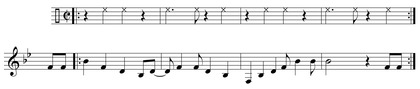
The syncopated, but straight subdivision feel of Cuban music (as opposed to swung subdivisions) took root in New Orleans R&B during this time. Alexander Stewart states that the popular feel was passed along from "New Orleans—through James Brown's music, to the popular music of the 1970s," adding: "The singular style of rhythm & blues that emerged from New Orleans in the years after World War II played an important role in the development of funk. In a related development, the underlying rhythms of American popular music underwent a basic, yet generally unacknowledged transition from a triplet or shuffle feel to even or straight eighth notes.[51] Concerning the various funk motifs, Stewart states that this model "... is different from a time line (such as clave and tresillo) in that it is not an exact pattern, but more of a loose organizing principle."[52]
Johnny Otis released the R&B mambo "Mambo Boogie" in January 1951, featuring congas, maracas, claves, and mambo saxophone guajeos in a blues progression.[53] Ike Turner recorded "Cubano Jump" (1954) an electric guitar instrumental, which is built around several 2–3 clave figures, adopted from the mambo. The Hawketts, in "Mardi Gras Mambo" (1955) (featuring the vocals of a young Art Neville), make a clear reference to Perez Prado in their use of his trademark "Unhh!" in the break after the introduction.[54]
Ned Sublette states: "The electric blues cats were very well aware of Latin music, and there was definitely such a thing as rhumba blues; you can hear Muddy Waters and Howlin' Wolf playing it."[55] He also cites Otis Rush, Ike Turner and Ray Charles, as R&B artists who employed this feel.[55]
The use of clave in R&B coincided with the growing dominance of the backbeat, and the rising popularity of Cuban music in the U.S. In a sense, clave can be distilled down to tresillo (three-side) answered by the backbeat (two-side).[56]


The "Bo Diddley beat" (1955) is perhaps the first true fusion of 3–2 clave and R&B/rock 'n' roll. Bo Diddley has given different accounts of the riff's origins. Sublette asserts: "In the context of the time, and especially those maracas [heard on the record], 'Bo Diddley' has to be understood as a Latin-tinged record. A rejected cut recorded at the same session was titled only 'Rhumba' on the track sheets."[55] Johnny Otis's "Willie and the Hand Jive" (1958) is another example of this successful blend of 3–2 claves and R&B. Otis used the Cuban instruments claves and maracas on the song.

Afro-Cuban music was the conduit by which African American music was "re-Africanized", through the adoption of two-celled figures like clave and Afro-Cuban instruments like the conga drum, bongos, maracas and claves. According to John Storm Roberts, R&B became the vehicle for the return of Cuban elements into mass popular music.[57] Ahmet Ertegun, producer for Atlantic Records, is reported to have said that "Afro-Cuban rhythms added color and excitement to the basic drive of R&B."[58] As Ned Sublette points out though: "By the 1960s, with Cuba the object of a United States embargo that still remains in effect today, the island nation had been forgotten as a source of music. By the time people began to talk about rock and roll as having a history, Cuban music had vanished from North American consciousness."[59]
.png)
At first, only African Americans were buying R&B discs. According to Jerry Wexler of Atlantic Records, sales were localized in African-American markets; there were no white sales or white radio play. During the early 1950s, more white teenagers started to become aware of R&B and began purchasing the music. For example, 40% of 1952 sales at Dolphin's of Hollywood record shop, located in an African-American area of Los Angeles, were to whites. Eventually, white teens across the country turned their musical taste toward rhythm and blues.[60]
Johnny Otis, who had signed with the Newark, New Jersey–based Savoy Records, produced many R&B hits in 1951, including "Double Crossing Blues", "Mistrustin' Blues" and "Cupid's Boogie", all of which hit number one that year. Otis scored ten top ten hits that year. Other hits include "Gee Baby", "Mambo Boogie" and "All Nite Long".[61] The Clovers, a quintet consisting of a vocal quartet with accompanying guitarist, sang a distinctive-sounding combination of blues and gospel.[62] They had the number five hit of the year with "Don't You Know I Love You" on Atlantic.[61][63][64] Also in July 1951, Cleveland, Ohio DJ Alan Freed started a late-night radio show called "The Moondog Rock Roll House Party" on WJW (850 AM).[65][66] Freed's show was sponsored by Fred Mintz, whose R&B record store had a primarily African-American clientele. Freed began referring to the rhythm and blues music he played as "rock and roll".
In 1951 Little Richard Penniman began recording for RCA Records in the jump blues style of late 1940s stars Roy Brown and Billy Wright. However, it was not until he recorded a demo in 1954 that caught the attention of Specialty Records that the world would start to hear his new uptempo funky rhythm and blues that would catapult him to fame in 1955 and help define the sound of rock 'n' roll. A rapid succession of rhythm and blues hits followed, beginning with "Tutti Frutti"[67] and "Long Tall Sally", which would influence performers such as James Brown,[68] Elvis Presley,[69] and Otis Redding.[68]
Also in 1951, the song Rocket 88 was recorded by Ike Turner and his Kings of Rhythm at a studio owned by Sam Phillips with the vocal by J

